Prokaryotic cells are very minute primitive type of cells, lacking true nucleus and membrane-bound organelles. Organisms with prokaryotic cell structure are called prokaryotes.
Characteristics of Prokaryotic Cell
- Unlike eukaryotic cell which are large in size and complex in structure and functions, the prokaryotic cells are the simplest and typically small in size (1-10 µm).
- They have a single envelope system and, as suggested by their name, possess a primitive form of the nucleus.
- Cells contain a central nuclear region, often called the nucleoid, which houses essential biomolecules like nuclear proteins and DNA.
- Neither the nuclear material nor respiratory enzymes are enclosed within membranes.
- Instead, enzymes may attach to the inner surface of the plasma membrane.
- These types of cells lack distinct cytoplasmic organelles such as the endoplasmic reticulum, mitochondria, centrioles, and Golgi bodies.
- Reproduction typically occurs vegetatively, with binary fission and budding being common methods in prokaryotes.
- Sexual reproduction is generally absent, but when present, it involves one-way gene transfer from a donor to a recipient.
- Nutrition is primarily through absorption, although some blue-green algae can produce their own food due to the presence of photosynthetic pigments.
Components of Prokaryotic Cell – Prokaryotic Cell Structure
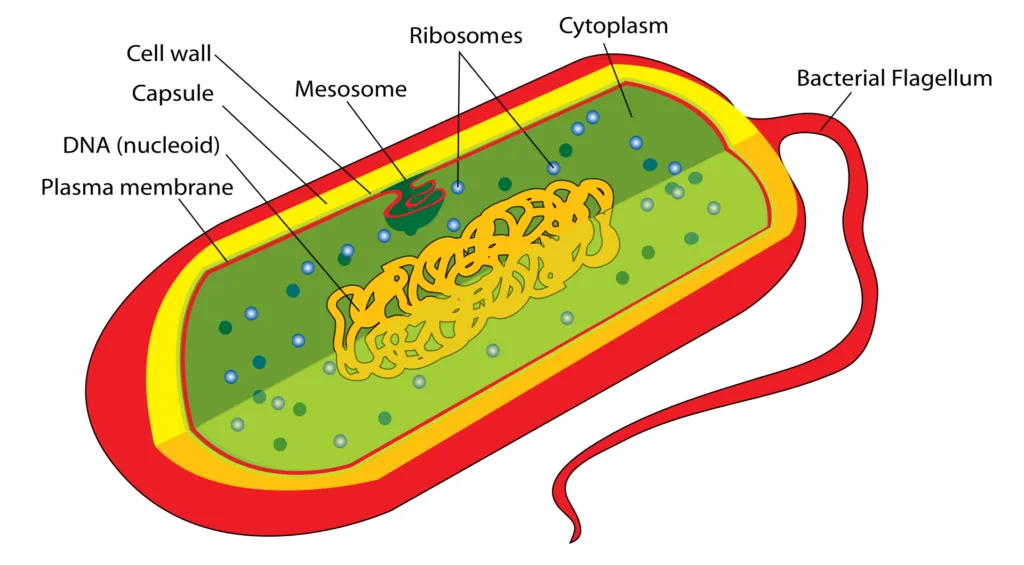
The structure of Prokaryotic cell can be differentiated into major six components;
- Outer covering
- Cytoplasm
- Nucleoid
- Plasmid
- Flagellum
- Pilli
Outer covering:
The outer covering of the bacterial cell possesses three layers i.e.
- Slimy capsule:
- The slimy capsule is a gelatinous layer outside the cell wall, mainly made of polysaccharides, though it may also contain polypeptides and other compounds.
- This capsule protects the cell from drying out, viral infections, phagocytosis, and antibiotics.
- Cell wall:
- The cell wall is a rigid or semi-rigid, non-living structure that encases the cell membrane, with a thickness ranging from 1.5 to 100 µm.
- Chemically, it is composed of peptidoglycans.
- However, some bacteria, such as mycoplasmas, lack a cell wall.
- Cell membrane:
- The cell membrane, composed of lipids and proteins, is thin, flexible, and regulates the movement of molecules in and out of the cell.
- It also carries respiratory enzymes for energy-releasing reactions. Mesosomes, which are in-folding of the plasma membrane, contain respiratory enzymes and function similarly to the mitochondria in eukaryotic cells.
- Additionally, in photosynthetic cells, pigments and enzymes that capture and convert light into chemical energy are found on plasma membrane in-folds called photosynthetic lamellae, which are analogous to chloroplasts in eukaryotic cells.
- The plasma membrane also aids in the replication and division of nuclear material.
- As these in-folding remain continuous with the cell membrane, they do not form separate compartments, making the prokaryotic cell non-compartmentalized.
Cytoplasm:
The prokaryotic cytoplasm contains proteins, lipids, glycogen, inorganic ions, and enzymes needed for biosynthesis, along with ribosomes, tRNA, and mRNA for protein production. Some unique characteristics of the prokaryotic cytoplasm include the following:
- Prokaryotic cells lack cell organelles such as the endoplasmic reticulum, mitochondria, Golgi apparatus, centrosomes, vacuoles, lysosomes, microfilaments, intermediate filaments, and microtubules.
- Ribosomes are the only cytoplasmic organelles found in prokaryotic cells. They are smaller than eukaryotic ribosomes (70S) and are free-floating in the cytoplasm. During protein synthesis, they form poly-ribosomes and serve as the sites of protein production.
- Unlike eukaryotic cells, prokaryotic cytoplasm does not display streaming movement or cyclosis.
- Some prokaryotic cells also produce gas vacuoles.
- The cell does not perform phagocytosis, pinocytosis, or exocytosis; substances move in and out through the cell membrane.
- Prokaryotic cells may contain polysaccharide deposits or inorganic phosphate reserves.
Nucleoid:
A nuclear envelope is absent in prokaryotic cells, so the genetic material is located directly within the cytoplasm, where it is referred to as the nucleoid. The nucleoid consists of a highly coiled single pro-chromosome and has the following distinctive features:
- A short, simple pro-chromosome is present, which attaches to the cell membrane at least at one point.
- Typically, there is only a single chromosome copy, making the prokaryotic cell haploid.
- The DNA is “naked,” meaning it lacks association with histone proteins. It is double-stranded, helical, and circular.
- The DNA quantity is lower than in eukaryotic cells, encoding fewer proteins. DNA replication is continuous throughout the cell cycle, with transcription and translation occurring in the cytoplasm, and mRNA processing is unnecessary.
- Processes like meiosis, gamete formation, or fertilization are absent; however, conjugation occurs in some bacteria.
- There is no nucleolus.
- Membrane folds, or mesosomes, assist in distributing replicated chromosomes into daughter cells.
Plasmids:
- Some prokaryotic cells contain a small, circular, double-stranded DNA molecule in addition to the nucleoid, known as a plasmid.
- Plasmids range from 1,000 to 30,000 base pairs and typically encode proteins that help the organism resist antibiotics and other toxic substances.
Flagellum:
- The flagellum is a whip-like structure used for locomotion, found in many bacteria.
- It measures 150 Å in thickness and is 10 to 15 µm long. Since it lacks a surrounding membrane, the flagellum grows from its tip.
- It is made up of a filament and a basal body. The filament extends from the cell into the surrounding medium and consists of numerous intertwined spiral chains of a protein called flagellin.
- The basal body anchors the flagellum to the cell and provides the force needed for its rotation. It comprises various components and numerous proteins and is divided into two parts: the shaft and the hook.
Pilli:
- These are short, rod-shaped, non-motile structures known as fimbriae, found on many bacteria.
- They are composed of pilin protein and typically measure less than 10 nm in thickness.
- Fimbriae assist bacteria in adhering to surfaces, food sources, or each other.
- Additionally, some bacteria possess tubular structures called sex pili.
Prokaryotic cells possess all the biochemical processes needed to produce complex organic materials from simple organic precursors essential for life. Therefore, despite their simpler structure, prokaryotes are more versatile in their synthetic functions than eukaryotes.